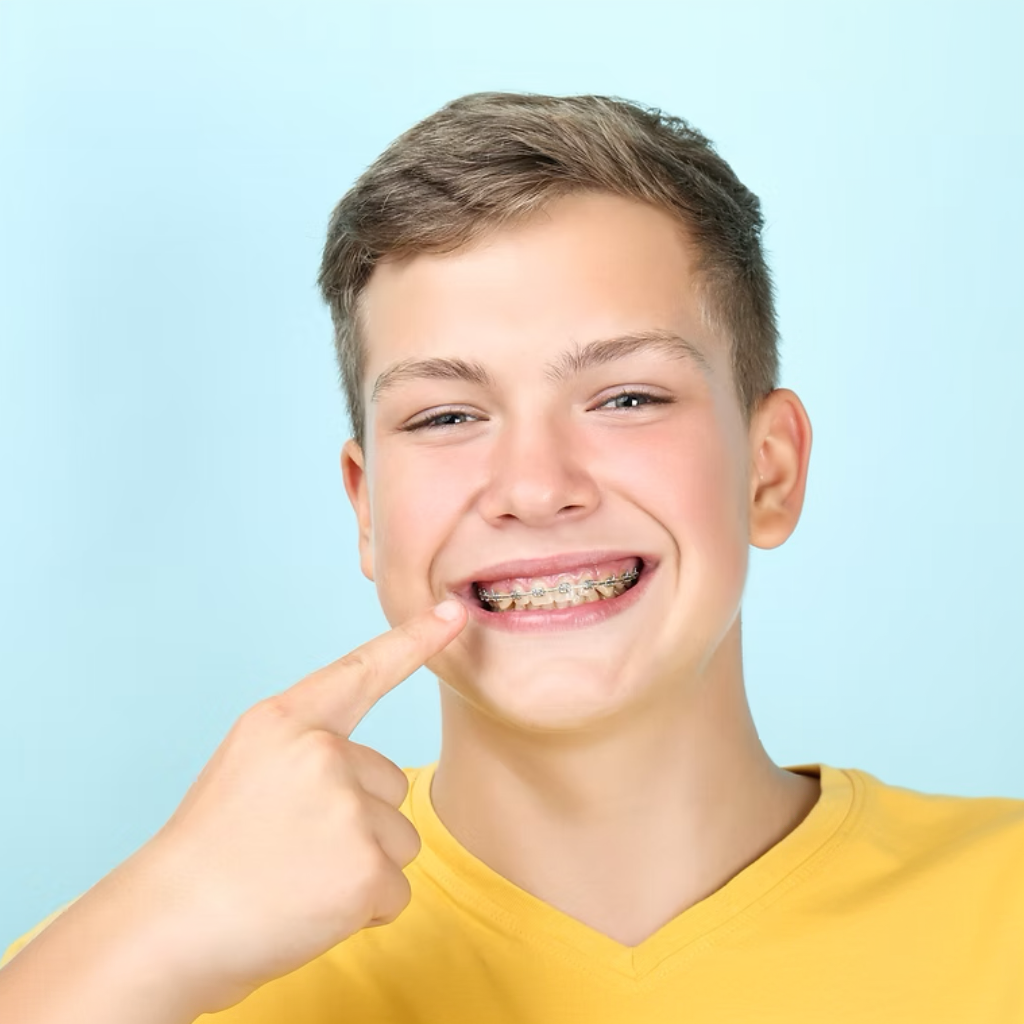


Gluck Orthodontics explains how Smile Squad helps Nashville families monitor growth and find the right time to begin orthodontic treatment.
KEY TAKEAWAYS
- ✓ The American Association of Orthodontists (AAO) recommends a first orthodontic check-up no later than age 7. A check-up is not the same as starting treatment.
- ✓ Many children do not need treatment at 7. Waiting for more adult teeth can make treatment shorter and simpler.
- ✓ A Cochrane review of 27 randomized trials found that treating protruding front teeth early lowered the risk of injury to those teeth, with no other clear advantage over starting in the early teens.
- ✓ Smile Squad is our growth-monitoring program: about 20 minutes every 6 to 12 months, with Dr. Jono tracking teeth, bite, and jaw growth.
- ✓ Some problems, like crossbites and underbites, do benefit from early care. Regular monitoring is how we catch them on time.
You brought your 7-year-old in for a first orthodontic visit. Then our team reviewed the photos and X-rays and told you something you did not expect: it is not time to start yet.
If you left wondering why we would wait, you are not alone. It is a question we hear often from parents across Nashville, from Green Hills and Belle Meade to Brentwood and East Nashville.
Here is why waiting is often the smartest next step, what the research says, and how our Smile Squad program keeps your child on track until the timing is right.
What Happens at Your Child’s First Orthodontic Visit?
The AAO recommends that every child see an orthodontist no later than age 7. By then, most kids have a mix of baby teeth and adult teeth. That mix gives an orthodontist an early look at how the teeth and jaws are growing together.
At your child’s first visit with us, we take photos, X-rays, and measurements. Dr. Jono reviews them with you and explains what he sees. And yes, there may be ice cream.
Age 7 orthodontics is about information, not braces. The AAO describes three possible outcomes from that first check-up, and we think of them this way:
Clear
Your child’s teeth and jaws are on track, and no treatment is expected.
Watch
Treatment may be needed later, so we check in as your child grows. This is Smile Squad.
Treat
A developing problem would benefit from early care, and we explain exactly why.
Many parents expect the third answer. A lot of children land in the second, and that is good news.
Why Would an Orthodontist Wait to Start Treatment?
A 7-year-old’s smile is a work in progress. Between now and the early teen years, your child will lose all 20 baby teeth, and adult teeth will grow in to replace them. The jaws keep growing the whole time.
Braces and Invisalign® aligners work best on adult teeth, not on baby teeth. Starting full treatment before those teeth arrive can mean a longer stretch in appliances, and sometimes a second round of treatment later.
Growth matters, too. Some bite problems are easier to correct during a growth spurt, and that window is different for every child. Watching your child grow helps us find the right window instead of guessing.
Not every child needs early treatment. When we recommend waiting, we are choosing the moment when treatment will do the most good.
Waiting on purpose is a plan, not a delay. For many families, it means fewer appointments, less time in braces, and a lower total cost than two separate rounds of treatment.
What Does the Research Say About Starting Early?
What Is Smile Squad?
Smile Squad is our growth-monitoring program for kids who may not need treatment yet but should be watched as they grow. It is the heart of how we approach pediatric orthodontics.
If Dr. Jono or Dr. Joel do not recommend treatment at the first visit, your child joins Smile Squad. Here is what happens at each check-in:
- We check baby teeth coming out and adult teeth coming in.
- We watch jaw growth and how the bite lines up.
- We take updated photos, digital impressions, or X-rays when needed.
- We share what we see and what comes next, before you leave.
Visits usually take about 20 minutes and happen every 6 to 12 months. Our office opens at 7 in the morning on Wednesdays and Thursdays, so many visits can fit in before the school bell.
When the time is right, Dr. Jono and Dr. Joel will build a treatment plan with you. Here is how Smile Squad compares with active treatment:
Smile Squad vs. Active Orthodontic Treatment
| Smile Squad |
Early (Phase 1) Treatment |
Comprehensive Treatment |
|
|---|---|---|---|
| What it is |
Growth monitoring with no appliances |
Targeted care for a specific problem |
Full braces or Invisalign to finish the smile |
| Typical ages |
Around age 7 until treatment is needed |
Usually ages 7 to 10 |
Usually once most adult teeth are in |
| Visits |
About 20 minutes, every 6 to 12 months |
Regular visits during treatment |
Every 4 to 8 weeks |
| Length |
Until the timing is right |
Depends on the problem |
12 to 36 months on average |
Our guide on how long braces take explains what shapes that 12 to 36 month range.
When Does Early Treatment Make Sense?
Some problems are easier to fix while a child is still growing, and Smile Squad visits are built to catch them:
- A crossbite, where upper teeth bite inside the lower teeth
- An underbite, where the lower jaw sits forward
- Upper front teeth that stick out far enough to risk injury
- Severe crowding that blocks adult teeth from coming in
- Baby teeth lost too early, leaving too little room
- A thumb-sucking habit that is changing the bite
If we see one, we will explain what we want to fix and why it should not wait. Our article on the truth about early orthodontic treatment goes deeper on Phase 1 care.
How Can Parents Help Between Smile Squad Visits?
You see your child’s smile every day. Mention any of these at your next visit, or call sooner if something changes:
- Trouble chewing or biting
- Breathing through the mouth
- Thumb or finger sucking that continues
- Crowded, misplaced, or blocked-out teeth
- A jaw that shifts or makes sounds
- Baby teeth that fall out much earlier or later than classmates’ teeth
Tying Smile Squad visits to the school calendar, like back-to-school season or summer break, makes them easy to remember. Keep up regular dental cleanings, too, since your family dentist and our team work side by side.
Why Nashville Families Choose Gluck Orthodontics
Choosing a child orthodontist is a big decision. Here is what sets our practice apart:
- A father-and-son team: Dr. Joel opened the practice in 1983, and Dr. Jono guides Smile Squad families from the first visit to the right start date.
- Honest recommendations: We recommend treatment only when it is truly needed, and we explain why.
- Proven trust: More than 40 years serving Nashville and more than 1,100 five-star Google reviews.
- Board Certified expertise: Both doctors are Board-certified Orthodontic Specialists.
- Options for every age: Braces and Invisalign for children, teens, and adults.
- One convenient office: Our Green Hills location serves Belle Meade, Brentwood, Forest Hills, 12 South, Sylvan Park, Franklin, and beyond.
The Final Answer
Frequently Asked Questions
Does my child need braces at age 7?
Usually not. The age 7 visit is a check-up, not a treatment start, and many children do not need treatment yet. If that is true for your child, Smile Squad lets our team monitor growth and recommend care only when the timing is right, which for most kids comes after more adult teeth arrive.
How often are Smile Squad visits?
Smile Squad visits usually happen every 6 to 12 months, depending on your child’s age and stage of development. Each visit takes about 20 minutes. We check baby teeth coming out, adult teeth coming in, jaw growth, and bite alignment, and we share what we see before you leave.
Is Smile Squad the same as early orthodontic treatment?
No. Smile Squad is an observation and growth-monitoring program, so your child does not wear braces, aligners, or any appliance while in it. Early treatment, sometimes called Phase 1, is active treatment for a specific problem. Smile Squad visits help us decide whether your child ever needs it.
How long does orthodontic treatment take once it starts?
Treatment time depends on your child’s age, how complex the problem is, and the type of treatment. On average, it ranges from 12 to 36 months. Starting at the right time, instead of too early, can help keep treatment focused and avoid a second round later.
Sources
Batista, K. B. S. L., Thiruvenkatachari, B., Harrison, J. E., & O’Brien, K. D. (2018). Orthodontic treatment for prominent upper front teeth (Class II malocclusion) in children and adolescents. Cochrane Database of Systematic Reviews, Issue 3, Art. No. CD003452. View in the Cochrane Library
O’Brien, K., Wright, J., Conboy, F., et al. (2009). Early treatment for Class II Division 1 malocclusion with the Twin-block appliance: a multi-center, randomized, controlled trial. American Journal of Orthodontics and Dentofacial Orthopedics, 135(5), 573-579. View on PubMed
American Association of Orthodontists. Child Orthodontics. View AAO resource
American Association of Orthodontists. What Are the Benefits of Early Orthodontic Treatment? View AAO resource
This blog is intended for general educational purposes only and is not a substitute for personalized medical, dental, or orthodontic advice. Please contact Gluck Orthodontics or your healthcare provider with questions about your child’s orthodontic care.